
- All
- Product Name
- Product Keyword
- Product Model
- Product Summary
- Product Description
- Multi Field Search
English
Views: 0 Author: Site Editor Publish Time: 2026-09-15 Origin: Site


Procuring textile wet processing machinery represents a high-stakes capital investment for any production facility. Your equipment choice directly dictates production yield, utility overhead, and final product quality. Knitted and elastic fabrics remain highly vulnerable during wet processing. They suffer from dimensional instability, crease marks, surface pilling, and severe loss of elasticity when subjected to high-tension conditions. Standard processing methods often fail to protect the delicate loop structure of these textiles.
The jet overflow dyeing machine serves as the industry-standard solution for low-tension, high-penetration rope-form processing. It synthesizes aggressive dye application with gentle fabric transport. This technology establishes a reliable framework for evaluating technical specifications, operational trade-offs, and overall production efficiency in modern dye houses. We will break down the mechanical configurations, success criteria, and implementation strategies required to optimize your dye house operations.
Tension Control is Paramount: Hybrid jet overflow systems combine the gentle fabric transport of overflow dyeing with the high dye-penetration of jet dyeing, making them non-negotiable for delicate knitted fabric dyeing.
Liquor Ratio Dictates Profitability: Modern machines must achieve ultra-low liquor ratios (often 1:4 to 1:6) to remain competitive against rising water, steam, and effluent treatment costs.
Nozzle Architecture Drives Quality: The design of the high-pressure pump and nozzle system determines the success of elastic fabric dyeing by preventing rope marks and ensuring even dye distribution.
Automation Reduces Batch Variation: Advanced programmable logic controllers (PLCs) and IoT-enabled sensors are required to standardize dosing, heating gradients, and circulation speeds, mitigating operator-induced errors.
Modern hybrid systems vastly outperform traditional winch becks and beam dyeing equipment. Legacy winch becks pull fabric through a static dye bath using sheer mechanical force. This action stretches knitted loops longitudinally while shrinking the fabric width. Beam dyeing flattens the fabric against a perforated cylinder. It destroys the natural hand feel and bulk of knitted constructions. Neither legacy method provides necessary dye penetration without compromising the physical integrity of the textile.
A pure jet dyeing machine utilizes high hydraulic pressure to propel the fabric rope through a venturi tube. It delivers rapid transport and aggressive dye penetration. However, this high-velocity process generates significant tension. It damages delicate fibers and permanently stretches elastane blends. Conversely, a pure overflow dyeing machine relies entirely on gravity. It cascades dye liquor over a weir to gently push the fabric forward. This method eliminates tension but lacks the hydraulic force required for deep dye exhaustion in dense synthetic blends.
Hybrid systems synthesize the strengths of both technologies. They utilize a gentle overflow weir to initiate fabric transport without mechanical pulling. Simultaneously, they deploy atomized jet nozzles inside the transport tube. This dual-action mechanism ensures maximum dye liquor exchange while maintaining a completely relaxed fabric state.
Technology Type | Transport Mechanism | Tension Level | Dye Penetration | Best Suited For |
|---|---|---|---|---|
Pure Jet | High-pressure hydraulic venturi | High | Excellent | Heavy woven synthetics |
Pure Overflow | Gravity-driven weir cascade | Very Low | Moderate | Lightweight delicate knits |
Hybrid Jet Overflow | Combined weir and atomized nozzles | Low | Excellent | Elastic blends, dense knits |
The structural geometry of the dyeing chamber dictates how the fabric rope flows and accumulates during the processing cycle. L-shaped or long-tube designs feature a horizontal storage chamber. They require a larger floor footprint but allow the fabric to glide with minimal friction. This horizontal orientation reduces the weight burden on the fabric rope. It prevents longitudinal stretching in highly sensitive synthetic blends.
Compact U-box designs maximize vertical space. They accommodate heavier fabric weights per batch. The fabric stacks vertically in the U-shaped chamber, utilizing gravity to assist the downward flow. Vertical stacking increases the risk of compression marks at the bottom of the pile, especially for heavy GSM fabrics.
J-box geometry represents the optimal configuration for continuous circulation. The chamber curves asymmetrically, resembling the letter J. This slope allows the fabric rope to slide down naturally without folding back on itself. The J-box specifically prevents fabric tangling and knotting. It ensures a smooth, uninterrupted transition from the storage chamber back up to the transport winch.
The high-pressure centrifugal circulation pump drives the entire fluid dynamic system. It must maintain consistent dye liquor flow rates regardless of temperature fluctuations. Operators control the pump speed using variable frequency drives (VFDs) to match the specific fabric weight. Heat exchangers integrate directly into the circulation loop. They elevate the dye bath temperature rapidly to achieve fixation. They must distribute heat evenly to prevent localized dye striking, which causes irreversible color patches.
The fabric transport winch synchronizes perfectly with the liquor flow. It lifts the fabric rope from the storage chamber and feeds it into the nozzle assembly. If the winch rotates faster than the fluid velocity, it mechanically pulls the fabric, creating tension. If it rotates too slowly, the fluid overtakes the fabric, causing slippage and surface scuffing. Precise synchronization guarantees tensionless movement throughout the continuous loop.
Successful knitted fabric dyeing demands strict dimensional stability. Knits, especially those incorporating spandex or elastane, must recover their original loop structure post-dyeing. High temperatures temporarily soften synthetic fibers. If the machine applies tension during this vulnerable state, the loops deform permanently. The fabric loses its inherent stretch and recovery properties.
Synchronized winch speeds and variable liquor flow rates prevent longitudinal stretching. The fabric rope must float through the transport tube rather than being dragged. Controlling the speed differential between the mechanical reel and the hydraulic flow ensures the fabric maintains its natural width. It prevents the edges from curling or shrinking inward during the high-temperature fixation phase.
Rope-form dyeing inherently risks creating permanent crease marks. When fabric gathers into a rope, it folds randomly. If polyester knits cool rapidly while folded, the thermal shock sets the creases permanently into the fiber structure. Gradual cooling gradients are mandatory to release these temporary folds before they become permanent defects.
Mechanical friction causes surface pilling and abrasions. Modern machines utilize automated plaiting mechanisms. These devices swing back and forth, folding the fabric rope neatly into the storage chamber. Organized folding prevents chaotic tangles and reduces the physical pressure on the fabric surface. Furthermore, manufacturers line the internal transport tubes with PTFE. This ultra-smooth surface minimizes drag, protecting delicate yarn filaments from breaking and pilling.
To troubleshoot and prevent crease marks on the production floor, operators should follow these specific steps:
Verify the cooling gradient does not exceed 1.5°C per minute when dropping from 130°C to 85°C.
Check the plaiter swing speed to ensure the fabric folds evenly across the entire width of the J-box.
Inspect the PTFE lining inside the transport tube for deep scratches or wear that could catch the fabric.
Ensure the nozzle pressure is adequate to balloon the fabric rope slightly, preventing tight, repetitive folds.
Dye exhaustion and fixation metrics define color levelness. Disperse dyes require high thermal energy and mechanical action to penetrate dense polyester knits. Reactive dyes require extended time and perfectly uniform distribution to bond with cotton knits. Uneven application results in shaded batches or poor colorfastness.
Optimizing the continuous loop cycle time ensures maximum droplet atomization. The fabric rope must complete a full circuit through the machine every two to three minutes. This rapid turnover rate guarantees the fabric passes through the atomized dye spray frequently. High-frequency exposure ensures the dye liquor penetrates the core of the yarn bundle, rather than just coating the surface.
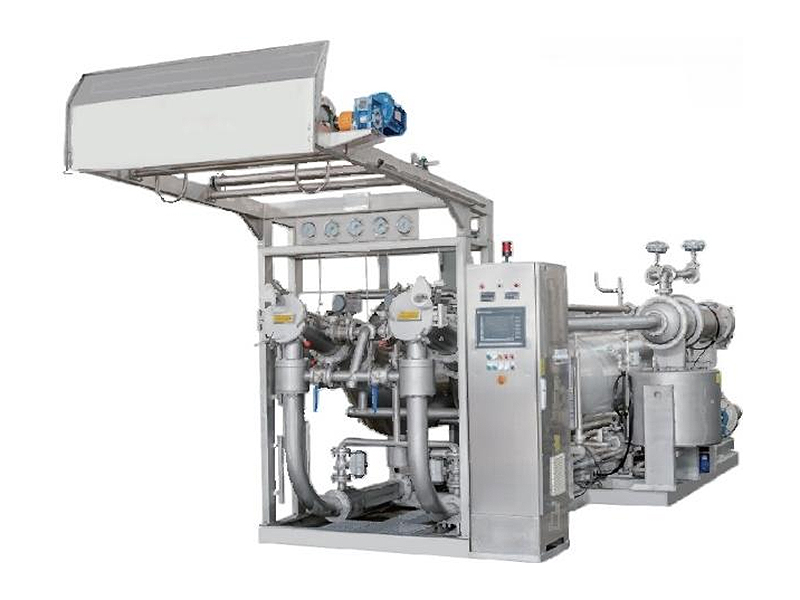
Evaluating water consumption per kilogram of processed fabric reveals the true efficiency of textile dyeing equipment. The liquor ratio defines the weight of the fabric relative to the volume of water required. A 1:10 ratio means ten liters of water per kilogram of fabric. Modern systems push this boundary down to 1:4 or 1:5.
Low liquor ratios trigger cascading resource savings. Less water volume directly reduces the steam required to heat the dye bath to 130°C. It lowers the electrical load on the main circulation pump, as it moves less fluid mass. Furthermore, it drastically reduces the volume of auxiliary chemicals and salt required to achieve the correct concentration. These cumulative reductions streamline the entire wet processing operation.
Liquor Ratio | Water per 1000kg Batch | Steam Requirement | Chemical Usage | Operational Efficiency |
|---|---|---|---|---|
1:10 (Legacy) | 10,000 Liters | Very High | High | Poor |
1:7 (Standard) | 7,000 Liters | Moderate | Moderate | Average |
1:4 (Modern Hybrid) | 4,000 Liters | Low | Low | Excellent |
Nozzle architecture dictates fluid dynamics inside the transport tube. Adjustable nozzles allow operators to widen or narrow the fluid gap. A narrow gap increases fluid velocity for heavy GSM fabrics. A wider gap increases fluid volume for lightweight, delicate fabrics. Fixed nozzles lack this adaptability, limiting the machine's versatility across different product lines.
Soft-flow nozzle technology proves critical for elastic fabric dyeing. Soft-flow designs prioritize fluid volume over sheer velocity. They envelop the fabric rope in a thick cushion of dye liquor. This hydraulic cushion protects the elastane core from high-impact fluid strikes. It prevents fiber degradation and ensures the fabric retains its maximum stretch percentage after processing.
Manual chemical additions cause uneven dye strikes. Automated dosing systems inject dyes and auxiliaries into the circulation loop precisely. They follow pre-programmed curves, adding chemicals linearly or exponentially based on the dye class. This automation prevents sudden spikes in concentration that cause localized spotting.
Programmable logic controllers (PLCs) manage heating and cooling gradients. Rapid temperature changes cause oligomer deposits in polyester processing. Oligomers migrate from inside the fiber to the surface, creating a white, powdery residue that ruins the fabric finish. PLCs strictly enforce a 1°C to 2°C per minute heating rate to prevent this migration. Future equipment developments include IoT integration and smart sensors. These upgrades provide real-time liquor ratio monitoring and predictive maintenance alerts, ensuring continuous production stability.
Procurement teams must balance massive-capacity single machines against multi-chamber configurations. Single, high-capacity machines offer excellent economies of scale for massive, uniform production runs. They require less floor space per kilogram of output and simplify batch tracking. Running a 1000kg machine for a 300kg order wastes massive amounts of water and thermal energy.
Multi-chamber machines provide superior operational flexibility. A unit with four 250kg chambers can run a full 1000kg batch or isolate chambers for smaller runs. More importantly, chamber capacity dictates the fabric rope length. If a single chamber holds too much fabric, the rope becomes excessively long. The circulation cycle time exceeds the optimal three-minute window. Extended cycle times lead to uneven dye exhaustion and severe temperature variations between the front and back of the rope.
High-temperature, high-pressure environments accelerate component wear. Maintenance teams must monitor the mechanical seals on the main circulation pumps continuously. Seal failure causes immediate pressure loss and catastrophic dye liquor leaks. Nozzle assemblies require frequent inspection. Lint and unexhausted dye agglomerate inside the nozzle gap, altering the fluid velocity and causing rope marks.
Heat exchanger scaling represents another significant maintenance reality. Hard water and chemical residues bake onto the internal heating coils. This scale acts as an insulator, drastically increasing the time and steam required to heat the dye bath. Facility managers must evaluate the ease of access for internal cleaning. Fast changeovers between dark navy batches and light pastel batches require smooth internal welds and accessible filter baskets to prevent cross-contamination.
Standard maintenance protocols should include:
Weekly inspection of main pump mechanical seals for micro-leaks.
Bi-weekly removal and manual cleaning of the nozzle assembly to clear lint buildup.
Monthly acid washing of the heat exchanger coils to remove hard water scaling.
Quarterly calibration of the PLC temperature probes against a manual thermometer.
Annual replacement of the PTFE lining in the transport tube if deep scratches are detected.
Manual intervention introduces the highest risk of batch failure. Incorrect loading techniques cause the fabric rope to tangle inside the transport tube. When the rope knots, it blocks the fluid flow. The machine shuts down on high-pressure alarms, and the stationary fabric absorbs dye unevenly, ruining the batch.
Facilities must implement strict standard operating procedures (SOPs) for machine loading. Operators must base chamber capacities on the fabric's GSM and physical volume, rather than sheer weight. A 200kg batch of lightweight fleece occupies significantly more volume than a 200kg batch of dense jersey. Overloading based on weight alone guarantees internal tangling and poor dye penetration.
High-temperature wet processing generates complex, chemically dense wastewater. Environmental compliance requires facilities to manage both the toxicity and the thermal pollution of this effluent. Discharging 130°C water directly into treatment plants destroys the biological bacteria used to break down the waste.
Machine selection directly impacts effluent volume. Ultra-low liquor ratio machines discharge significantly less wastewater per batch. Facilities must integrate heat recovery systems into their drainage infrastructure. These systems pass the boiling effluent through a plate heat exchanger. They capture the thermal energy and use it to pre-heat incoming fresh water. This mitigates thermal pollution while slashing boiler fuel consumption.
Installing high-pressure dyeing equipment requires extensive facility preparation. The physical floor space footprint must account for the machine dimensions plus the clearance required to pull the winch reel for maintenance. Load-bearing requirements are immense. A fully loaded multi-chamber machine filled with water and wet fabric exerts massive static pressure on the concrete slab.
Infrastructure must support rapid utility delivery. The facility requires high-pressure steam piping headers capable of delivering consistent thermal energy without pressure drops. Water supply lines must provide sufficient flow rates to fill the machine rapidly. Undersized utility lines extend the non-productive filling and heating phases, destroying daily production schedules.
The jet overflow dyeing machine stands as the most viable technology for modern wet processing. It successfully balances the delicate, tensionless handling required by knitted fabrics with the aggressive hydraulic penetration necessary for synthetic blends. Mastering this technology ensures consistent color levelness, preserves fabric elasticity, and minimizes utility consumption.
To execute a successful equipment upgrade and optimize your dye house production, follow these immediate steps:
Request pilot-scale dye trials using your specific knitted fabric substrates to verify tensionless transport and stretch recovery.
Audit the manufacturer's utility consumption claims by reviewing live water and steam meter data from existing installations.
Evaluate the internal chamber geometry, favoring J-box designs to prevent tangling during continuous circulation.
Assess your facility's effluent infrastructure to ensure it can handle the specific wastewater volume and thermal load.
A: A pure jet machine uses high-pressure hydraulic force to push the fabric, creating high tension and rapid dye penetration. A pure overflow machine uses gravity to gently cascade water over a weir, moving the fabric with minimal tension but lower penetration. Hybrid machines combine both methods.
A: Knitted fabrics easily lose their loop structure and stretch under tension. The hybrid system provides tensionless transport, preventing the fabric from stretching or deforming. Simultaneously, the atomized nozzles ensure deep, even dye penetration into the dense yarn bundles without causing surface abrasion.
A: The liquor ratio measures water volume against fabric weight. Lower ratios drastically reduce the amount of water consumed. Consequently, you use less steam to heat the bath, less electricity to pump the fluid, and fewer chemicals to treat the resulting wastewater.
A: Processing elastane blends in standard high-tension jets is highly risky. The aggressive pulling force permanently stretches the spandex core, causing a complete loss of elasticity. It also increases the risk of setting permanent crease marks into the synthetic fibers during rapid cooling.
A: Tangling usually results from overloading the chamber, incorrect nozzle pressure, or mismatched winch speeds. Modern machines prevent this using automated plaiting systems that fold the fabric neatly, combined with J-box chamber designs that allow the rope to slide smoothly without knotting.
A: Maintenance teams must perform routine checks on the mechanical seals to prevent pressurized leaks. They must monitor vibration levels to detect bearing wear early. Regular cleaning of the inline filter baskets is also mandatory to prevent unexhausted dye from restricting the fluid flow.


